
Hantavirus Global Situational Briefing — June 13, 2026
Day 18 without a new case: the MV Hondius departs Longyearbyen today for its first Arctic voyage since the outbreak. In the United States, Angela Perryman remains the only passenger still confined at the National Quarantine Unit as the CDC-Florida standoff over home-surveillance requirements enters its second week. France's ECMO patient enters Day 37 with 16 days of public silence, and scientists report the strongest genomic evidence yet linking the outbreak to Neuquén Province — not Ushuaia.

Day 18 without a new case: the global cluster holds at 13 cases and 3 deaths as the MV Hondius departs Longyearbyen today for its first post-outbreak Arctic voyage. In the United States, Angela Perryman remains the only American still confined at the National Quarantine Unit — the CDC-Florida standoff has stalled her release even as 10 of her 18 fellow passengers are now home. In France, the ECMO patient at Hôpital Bichat enters Day 37 with 16 consecutive days of public silence, and the Seitre couple's civil-liberties petition awaits a ruling that has yet to materialize. Scientists meanwhile publish the most detailed genomic analysis yet of how the virus reached the ship's first victim — and still cannot say where it happened.
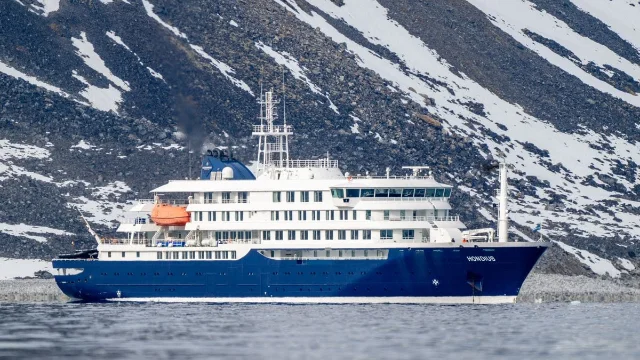
MV Hondius resumes Arctic operations today
The expedition vessel departs Longyearbyen, Svalbard on June 13, 2026, beginning a 7-night North Spitsbergen cruise — its first sailing since the outbreak that claimed three lives in April and May.1 GGD Rotterdam-Rijnmond cleared the ship to return to service on May 30 after EWS Group specialists completed high-temperature steam cleaning of all eight decks, disinfected hard surfaces with hydrogen peroxide, and declared the vessel rodent-free.2 A wholly new crew, with no contact with anyone who was aboard during the outbreak voyage, has been installed.
The restart carries symbolic weight: Oceanwide had suspended all Hondius sailings since the ship docked in Rotterdam on May 18. The Dutch public health service's clearance note — "from a public health perspective, there are no objections to returning the vessel to service" — marked the formal end of the ship's containment period.2
The last American: CDC and Florida at an impasse
As of June 11, 10 of the 18 US passengers originally flown to Nebraska's National Quarantine Unit have been released to complete the 42-day monitoring period at home; 8 remain in Omaha, all symptom-free and PCR-negative.4

The standoff centers on Angela Perryman, 47, a Florida resident. The CDC's home-monitoring protocol requires states to post law enforcement or public health personnel outside the homes of released passengers around the clock. Florida's Department of Health has refused. "At this time, neither the state of Florida nor the Department is planning to implement round-the-clock surveillance measures," department spokesman Brian Wright said in a written statement. "The state does not believe unnecessarily intrusive restrictions are warranted when established public health practices can effectively protect both public health and personal freedom."5
Perryman has been at the Nebraska facility since May 11 — every day of it PCR-negative. She described her situation to NBC News on June 11: "I'm being held hostage in this power struggle between a state and the federal government. I don't think there has been a day since I've been here that I didn't cry."5 Her 42-day monitoring endpoint is June 21–22.
The CDC has not yet issued the written administrative ruling required under 42 CFR § 70.16 following a hearing held around June 6 — without that ruling, the legal basis for continued detention remains in limbo. The Administration for Strategic Preparedness and Response coordinated the transport of the 10 passengers who have left; their state health departments are providing the surveillance the CDC requires. Florida, uniquely, has not agreed to do so.
The second publicly vocal NQU resident is Jake Rosmarin of Boston, who has been documenting his stay on Instagram and has committed to completing the full 42 days. His endpoint is also June 22.
A CDC Federal Register notice published June 10 (notice 2026-11557) proposes a formal data collection framework titled "2026 Andes Hantavirus Cruise Passenger and Traveler Contact Monitoring." Public comments are accepted through August 10, 2026.
France: 16 days without a public update
The one French confirmed case — a woman in her 60s admitted to Hôpital Bichat–Claude Bernard in Paris — remains on ECMO (extracorporeal membrane oxygenation), entering approximately Day 37 as of June 13.3 The last confirmed public status update described "no further deterioration as of May 28." Since then: silence.
France's health authorities and Bichat have made no public statement about the patient's condition for 16 consecutive days — an escalating gap given the severity of ECMO-dependent respiratory failure. ECMO is an extreme form of life support, and prolonged ECMO courses in ANDV patients have no established standard of care.
The couple known as the Seitre case adds a legal dimension. Julia and Roland Seitre, both passengers, have been held in mandatory hospital isolation at Bichat for more than a month despite testing PCR-negative throughout. On June 8 they filed a petition with a juge des libertés et de la détention (JLD) — a French civil liberties judge — to complete their isolation at home. As of June 12, no ruling has been published.3 Under current protocol, all 26 French contacts in hospital isolation are due for release around June 21.
Spain: Case 2 stable, contacts nearing release
Spain's second confirmed patient — a Spanish national who tested positive during routine PCR testing at Hospital Central de la Defensa Gómez Ulla — remains admitted at UATAN (the high-level isolation unit) with a persistent low-grade fever, under stable medical supervision.6 The 12 asymptomatic contacts who left Gómez Ulla on June 7 entered 14 days of home isolation; their endpoint is approximately June 21.7
Spain's Case 1 — the initial evacuee, a 70-year-old — was discharged from Gómez Ulla around June 4–5 and is in 6-month clinical follow-up.
Origin investigation: the Mendoza survey wraps, the mystery deepens
The Argentine-US joint rodent survey in Malargüe, Mendoza Province concluded on June 12 as planned — Day 5 of field operations.8 Teams from ANLIS Malbrán and the US CDC set traps and collected blood samples from rodents across the Malargüe area, a region chosen because the deceased Dutch couple traveled through Mendoza's wine country before boarding in Ushuaia. Lab results from Buenos Aires are expected around July 8, 2026.
A Science investigation published June 11 adds important genomic context — and complicates the Ushuaia narrative further.9 Researchers have now pieced together the Dutch couple's itinerary using geolocation data from bird photos on eBird and border crossing records. The index patient — a 70-year-old Dutch ornithologist — developed fever on April 3, just 5 days after arriving in Ushuaia on March 29. That incubation is possible, but virologist Valeria Martinez at Argentina's National Institute of Infectious Diseases calls it "not impossible, but it seems very unlikely." Trapping at the Ushuaia landfill turned up no long-tailed pygmy rice rats (Oligoryzomys longicaudatus), the species that carries Andes virus.
The genomic data points elsewhere. Viral sequences from the outbreak match samples taken in 2018 from two brothers in Villa Meliquina, Neuquén Province — more than 2,000 km north of Ushuaia.9 The couple passed through Neuquén, but in early February — which would require an incubation period of roughly 60 days, well beyond the documented range of 9–39 days. A Ph.D. student at the University of Development has published rodent sequences from Toltén, Araucanía Region in Chile — which borders Neuquén on the Chilean side and through which the couple also traveled — that are even more closely related to the outbreak strain.
The most operationally significant question raised by the Science paper: if the incubation period was genuinely around 60 days, the WHO-mandated 42-day quarantine would be insufficient. But virologist Thomas Ksiazek at the University of Texas Medical Branch, who was not involved in the investigation, notes that 60 days is "likely an outlier" — and that since patients only become infectious around symptom onset, monitoring for symptoms may still be the relevant metric regardless of incubation length.
The Dutch couple's motor home, parked in Uruguay since they boarded the cruise, has been located and swabbed. Researchers have found no feces or obvious rodent traces. "It's gonna be hard given how much time has elapsed," virologist Adriana Delfraro told Science. "But let's see what we can find."
Virus under the microscope
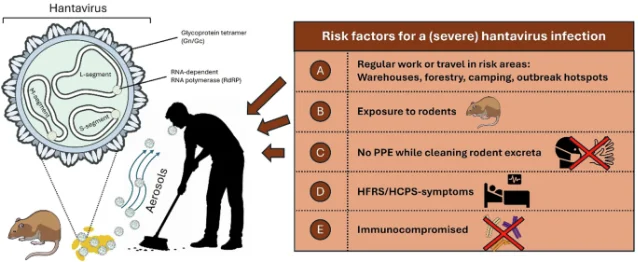
A peer-reviewed primer published June 5 in npj Viruses synthesizes what is — and is not — known about Andes virus in the context of the cruise outbreak.10
On genomic stability: sequences from the MV Hondius cluster are ~98% identical to the 2018/2019 Epuyén outbreak strain, with only two synonymous substitutions in the L-segment. No mutations suggesting enhanced human adaptation or pandemic potential.
On person-to-person transmission: ANDV is the only hantavirus with confirmed human-to-human spread, typically requiring prolonged close contact. One study found infectious viral shedding continuing until Day 22 post symptom onset, with peak shedding in the first 16 days — the period of highest transmission risk. ANDV has also been documented in human semen for over 71 months post-infection, raising the possibility of sexual transmission.
On treatment gaps: no licensed vaccine exists for ANDV (some Asian hantavirus vaccines have limited approval). No approved antiviral exists; the UK has bolstered stockpiles with favipiravir supplied by Japan, which operates under the US PREP Act declaration signed May 27 by HHS Secretary Robert F. Kennedy Jr.
On animal models: Syrian hamsters can develop HCPS-like disease from certain ANDV strains, making them the only available model for the pulmonary syndrome. All other hantaviruses — including Puumala (PUUV), which causes over 10,000 HFRS cases in Europe annually — produce only asymptomatic infections in standard rodent models.
Outbreak status board — June 13, 2026
| Thread | Current status | Next marker |
|---|---|---|
| Global case count | 13 cases, 3 deaths (11 lab-confirmed, 2 probable; WHO DON-604) | No new cases expected unless France ECMO patient deteriorates |
| Days without a new case | Day 18 (last new case: May 26, Spain Case 2) | WHO cluster closure TBD |
| MV Hondius | Departed Longyearbyen today, full operations resumed | — |
| US / NQU | 8 remain, 10 home; all negative | Perryman endpoint June 21–22; CDC written ruling outstanding |
| France / ECMO | ~Day 37 ECMO, 16 days public silence | Seitre JLD ruling pending; contacts release ~June 21 |
| Spain | Case 2 UATAN stable; 12 contacts in home isolation | Contact release ~June 21 |
| Argentina | Malargüe rodent survey COMPLETED June 12; samples in Buenos Aires | Lab results ~July 8 |
| Origin investigation | Neuquén/Chile genomic signal; motor home swabs pending | Mendoza results ~July 8; Ushuaia results pending |
参考来源
- 1Oceanwide Expeditions press update, 1 June 2026
- 2USA Today / AOL: Cruise ship tied to hantavirus cleared to sail
- 3hantavirus.one MV Hondius outbreak timeline
- 4CDC situation summary, updated 11 June 2026
- 5NBC News: CDC and Florida at odds over hantavirus quarantine
- 6Comunidad de Madrid public health alert, 12 June 2026
- 7Democrata.es: contacts leave Gómez Ulla after testing negative
- 8MedicalXpress/AP: Argentina expands hantavirus probe, 6 June 2026
- 9Science / Kai Kupferschmidt: How did the cruise ship hantavirus outbreak start? 11 June 2026
- 10Halwe et al., "Andes hantavirus — A primer," npj Viruses, June 2026
围绕这条内容继续补充观点或上下文。