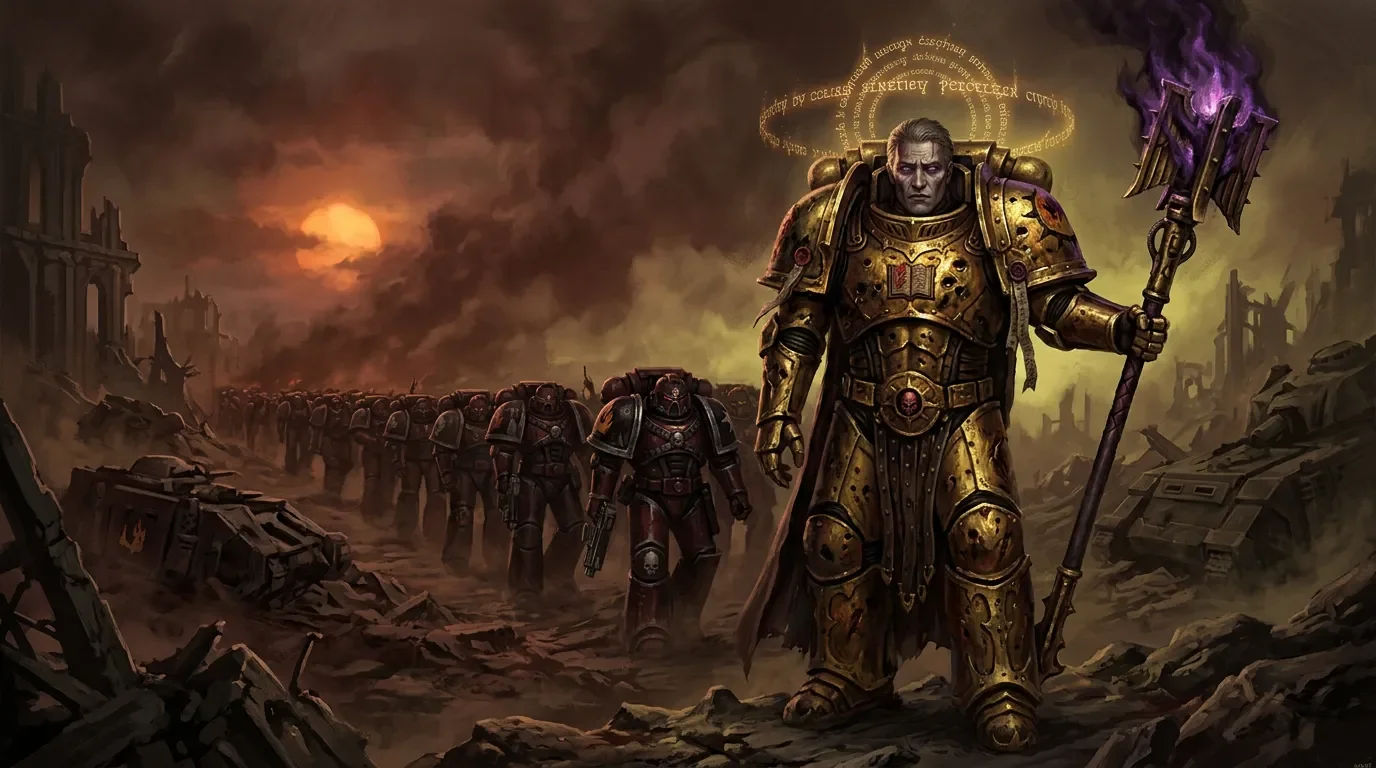
Lorgar Aurelian, Part II: The Heresy He Built
Part II of the Lorgar arc covers the Horus Heresy in full: Erebus's mission to Davin to corrupt Horus, the Drop Site Massacre at Isstvan V where Lorgar's masks came off, the ambush at Calth that irradiated an Ultramarine world, the Shadow Crusade with Angron through the heart of Ultramar, the massacre on Nuceria and the ritual that turned Angron into a Daemon Prince, the summoning of the Ruinstorm that split the Imperium in half — and Lorgar's failed coup against Horus, his exile, and his final ascension to Daemon Primarch of Chaos Undivided.
This is Part II of a three-part arc. Part I covered Lorgar's origins on Colchis, his reunion with the Emperor, the humiliation of Monarchia, and his pilgrimage into the Eye of Terror where the Chaos Gods offered him the truth he had always sought.
When the Word Bearers marched away from the ashes of Monarchia, their pace quickened — and for the first time in a century, worlds fell before them in rapid succession. Forty-three years of deception lay ahead. Lorgar had his new gods. Now he needed to give them a war.
The man sent to Davin
The trigger for the Horus Heresy was not a battle. It was a wound.
Erebus, First Chaplain of the Word Bearers and the man who had guided Lorgar into the Eye of Terror, was dispatched to the swamp world of Davin before the shooting started. There, working in concert with the native Chaos cult priests, he laid a trap for Warmaster Horus Lupercal. 1 A seemingly minor wound sustained during a campaign on Davin's moon was allowed to fester with Warp corruption. When Horus was carried half-dead to the Temple of the Serpent Lodge, the daemon that entered him during the healing ritual was Chaos's invitation to the greatest of the Emperor's sons.
Lorgar watched from a distance. He had chosen to move the pieces rather than appear on the board.
The Legion kept its true allegiance hidden for decades. The Word Bearers conquered and built and burned as ordered, their sermons now laced with the Primordial Truth rather than the Emperor's hollow secular doctrine, but delivered in the same golden cadences that had won them ten thousand worlds. They planted Chaos cults across every world they brought to Compliance. By the time Horus declared his revolt, the XVII Legion had already salted the ground. 2
Isstvan V: the masks come off
At Isstvan V, Lorgar's patience ended.
The Drop Site Massacre, planned by Horus as the moment when loyalist relief forces would be annihilated by four hidden Traitor Legions, was also the moment the Word Bearers stopped pretending. Lorgar and his warriors emerged from the Urgall Depression alongside the Night Lords, Alpha Legion, and Iron Warriors — the second wave that turned a loyalist landing into a killing field. 2
In the chaos of the slaughter, Lorgar found Corvus Corax, Primarch of the Raven Guard — one of the three loyalist primarchs personally targeted for death. The two fought, and by the testimony of the Warhammer sources, Corax had the upper hand. He came within reach of ending Lorgar there in the blood-soaked ash. Only the intervention of Konrad Curze, the Night Haunter, saved the Word Bearers' primarch. 1
Lorgar limped away from that encounter with the knowledge that he was not the warrior his brothers were. He knew this. He had always known it. His value was elsewhere — in architecture, in patience, in the long game that the other primarchs were too proud or too simple to play.
After the battle, at the Traitor War Council, he found Fulgrim. Or rather, he found what was wearing Fulgrim's skin.
The Primarch of the Emperor's Children had surrendered himself entirely to a Slaaneshi daemon — not a bond, but an eviction. Lorgar attacked him in a rage, beating the being with his fists, screaming at the daemonic passenger who had displaced his brother. Only Horus physically restrained him. 1 The Word Bearers primarch believed, deeply and theologically, in a partnership between mortal vessel and Warp entity — the daemon and the man arriving at something greater than either alone. What he saw in Fulgrim's empty eyes was an abomination, not an apotheosis.
He remembered that fury when he needed it later.
The knife at Calth
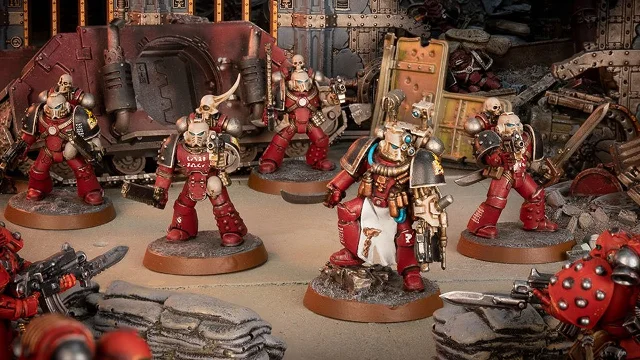
The Word Bearers had an old score to settle with the Ultramarines — and Lorgar had a theological reason to want it done.
It was Guilliman's XIII Legion that had razed Monarchia, that had stood there watching while Lorgar and every one of his sons knelt in the ashes of their own holy city. Horus gave the Word Bearers a mission: prevent the Ultramarines from marshalling their strength and reinforcing Terra. Lorgar took it, but the manner of execution was entirely his own.
Kor Phaeron, First Captain of the Word Bearers, led the main strike force to Calth — a major Ultramarine mustering world in Ultramar — under the pretence of a joint campaign briefing. The assault was years in the making. Word Bearers ships had been travelling slowly through the system for months, their weapons warm, their Daemon summoning circles already inscribed in the decks below the waterline. 4 When the signal came, they opened fire on the Ultramarines fleet in orbit and dropped troops into the mustering grounds below.
The surface of Calth burned. The star itself was turned into a weapon — a Warp ritual performed by the Word Bearers destabilised the local sun, flooding the surface with lethal radiation. Cities died. Hundreds of thousands of Ultramarines were killed outright or driven underground. The First Chaplain Erebus himself performed the ritual that seeded the first threads of the Ruinstorm — a Warp tempest that would, if properly fed, cut Ultramar off from the rest of the Imperium entirely. 4
Lorgar was not at Calth. He was elsewhere, doing the second part of his plan.
But the assault did not go cleanly. Kor Phaeron was wounded in a duel with Tetrarch Ultramarines officers and narrowly escaped death. The underground war on Calth — the Underworld War fought in the tunnels and vaults beneath the irradiated surface — dragged on for years, consuming Word Bearers resources that Lorgar had not budgeted for. When Ultramarines reinforcements from Macragge eventually arrived, the Word Bearers were driven from the Calth system entirely. 1
There is a reading of Calth — argued among lore scholars on Reddit with genuine heat — that Lorgar wanted this outcome, at least partly. He knew that Erebus and Kor Phaeron had manipulated him on Colchis. He knew Erebus had engineered the fall of Horus. Sending both men into the jaws of Guilliman's Legion, where they might die, served a quiet purpose. 5 Neither died. But the theology was clean: he had honored the mission, and he had given fate the chance to remove the men who had used him.
The Shadow Crusade
While Kor Phaeron bled on Calth, Lorgar was already moving with Angron and 100,000 Word Bearers alongside 150,000 World Eaters through the heart of Ultramar. 6 The stated mission was to keep Guilliman occupied and prevent the XIII Legion from reinforcing Terra. The real purpose was the Ruinstorm — and that required blood, suffering, and Warp-saturated carnage on a scale that would shake the Immaterium itself.
The relationship between Lorgar and Angron was always going to be difficult. Angron was not a strategist — he was an engine. The Butcher's Nails hammered into his skull before his rescue had rerouted the architecture of his brain toward violence, and as a Primarch they were slowly killing him, driving him toward a neurological collapse that no amount of bloodshed could relieve. He stopped the advance repeatedly to butcher worlds that had no tactical value, burning through time and ammunition on planets whose names no one would remember.
The tension between them cracked open into direct confrontation at least once. What ended the standoff was not reason but chaos — a Dark Eldar raid that struck both forces simultaneously, forcing a sudden and unlikely unity against a common enemy. 6
Lorgar watched Angron. He watched the rage, the pain, the way the Butcher's Nails fired and fired and fired. And he recognized something the Primarch of the World Eaters could not see himself: the path. Not annihilation. Apotheosis.
He had seen it at Isstvan V with Fulgrim — gone wrong, everything wrong — but the mechanism was real. The Chaos Gods could transform. The question was how.
The answer, Lorgar decided, lay on Nuceria.
The purge of a world
Angron had been born on Nuceria — or rather, had been taken from there. A gladiator slave fitted with experimental brain implants, he had led a rebellion that the Emperor ended by lifting him off the field in the middle of his last stand, leaving his companions to die while the slave-lords of Nuceria rewrote the story to say he had fled. 1
The slave-lords were still there when Lorgar and Angron arrived. They had built statues to celebrate their version of events. They had told the survivors — descendants of the very people Angron had fought to free — that their hero had been a coward.
What happened next was not a battle. It was an erasure.
Angron ordered the World Eaters and Word Bearers to kill everyone. Every slave-lord, every soldier, every citizen. Lorgar gave the command to his own warriors and waded into the slaughter himself. 1 The population of Nuceria was massacred as Angron descended into an ecstasy of vengeance that the Butcher's Nails amplified into something beyond fury.
And then Guilliman arrived.
The Ultramarines, pursuing the traitors from Calth with forty vessels against three massive traitor battleships (the Conqueror, the Fidelitas Lex, and the Trisagion), broke through the blockade at cost — losing twelve ships — and put boots on the ground. 6 What followed on the burning surface of Nuceria was something rarer than most battles in the Heresy: two Primarchs fighting directly, without armies deciding the outcome around them.
Guilliman and Lorgar dueled. The Lord of Macragge was bigger, faster, trained for war in a way that Lorgar simply was not. Lorgar held — but only just. When Angron arrived in the middle of it, the Red Angel drove Guilliman back through sheer violence, the Primarch of the Ultramarines escaping only because nearby warriors pulled him clear.
This, too, had gone according to plan.
While Angron's rage filled the sky above Nuceria, Lorgar had already started the ritual. The Khornate ceremony required a conduit of pure, uncontrollable fury at the exact moment of maximum carnage. Angron provided both, unknowingly. Lorgar channeled the power through the World Eaters Primarch, and the Chaos Gods answered. 6 The Butcher's Nails stopped their killing work. The brain damage reversed. The failing biological architecture of the World Eaters Primarch was rebuilt by Warp-stuff into something that did not need a human nervous system anymore.
Angron the man burned away. What rose from the blood of Nuceria was a Daemon Primarch of Khorne — vast, towering, wings of brass and skin of iron, a creature of rage without any remaining limit on what it could feel or do. The birth-scream rattled ships in orbit.
The Ruinstorm crested. The great Warp storm spread across Ultima Segmentum, cutting the Dark Angels and Blood Angels off from Terra alongside the Ultramarines, forcing Guilliman to retreat to Macragge and eventually declare Imperium Secundus — a shadow Imperium formed in isolation. 6 Lorgar had not destroyed Ultramar. He had done something more surgical: he had locked it out.
A prophet without use for prophets
The war continued, but Lorgar increasingly moved against its current.
He had started it. He understood its purpose. And now, watching Horus manage it, he concluded with cold certainty that the Warmaster was going to lose.
Horus refused to fully surrender to the Chaos Gods. He used them. He took their gifts without offering genuine devotion. For Lorgar, who had built his entire life on the premise that true worship demanded unconditional faith, this was not just a strategic miscalculation — it was a theological failing. A man who would not kneel to his gods would not be permitted to win. 3
He began planning a coup.
The details required patience. After Horus fell into a coma following the Battle of Beta-Garmon, Lorgar went aboard the Vengeful Spirit — the Warmaster's flagship — under the guise of consulting on the final push toward Terra. Alongside his lieutenant Zardu Layak, he moved the pieces into position. 1 Fulgrim, now a Daemon Primarch and largely absent from the war, needed to be retrieved and controlled. Lorgar, guided by the oracular disciples of Cyrene Valantion, navigated the Webway and located the Emperor's Children primarch in the Palace of Slaanesh — a being of pure narcissistic indulgence who had long since stopped caring about mortal wars.
He attacked Fulgrim. They fought — the Word Bearer and the Peacock — in the halls of a Chaos god's own domain. When the duel reached its crux, Zardu Layak spoke Fulgrim's true daemonic name aloud, a binding of absolute control that reduced the Daemon Primarch to a puppet. 1 Lorgar brought him, leashed, to the mustering at Ullanor — the great gathering of Traitor forces before the final advance on Terra.
The plan was clean. On Lorgar's signal, he would unleash a psychic scream that disorientated Horus. Zardu Layak would release Fulgrim, whose Emperor's Children would destroy the Sons of Horus in orbit. The Black Legion leaderless, the Word Bearers already in position — Lorgar steps forward and takes command. A new Warmaster, one who would prostrate himself properly before the Ruinous Powers.
It failed because someone talked.
Actaea, a prophetess among the Word Bearers, warned Horus. When Lorgar began the ritual, he was hit — hard and suddenly — before the first note of the psychic scream left him. Zardu Layak, sensing the trap spring, released Fulgrim without giving the attack signal. The Daemon Primarch did nothing. Horus beat Lorgar across Ullanor, and the Word Bearers primarch, characteristically, refused to fight back. He stood in the blows and expressed what he genuinely felt: pity. Grief for what his brother had become. A Chaos-touched giant throwing tantrums, too proud to kneel to the very beings whose power he was borrowing. 1
Horus ordered him gone. He told Lorgar that if he ever saw him again, he would kill him.
Lorgar left. Most of his followers sided with Zardu Layak and stayed with the Heresy forces. Lorgar took the rest — a significant but diminished portion of his Legion — and withdrew. Publicly, he declared that Horus's pride had doomed the rebellion. Privately, he had known it before the coup failed.
He was right. Horus died on Terra eight months later.
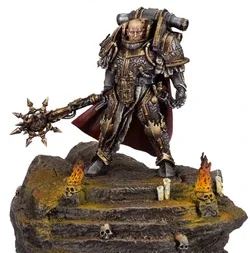
Exile and ascension
Lorgar did not attend the Siege of Terra. He was not present when Sanguinius died on the Vengeful Spirit's bridge, nor when the Emperor and Horus destroyed each other in the throne room above the planet. He received the news in whatever corner of the galaxy he had retreated to, and history does not record his reaction.
What it does record is what came after.
The Word Bearers' accumulation of atrocities across the Heresy — Calth, the Shadow Crusade, Nuceria, a hundred other massacres, a thousand rituals — had purchased something with the Dark Gods. The debt was paid. In the years after the Heresy's end, while Rogal Dorn and the surviving primarchs drew up lists of the traitors who had to be found and destroyed (Lorgar topped Dorn's list as the Imperium's most wanted), the Word Bearers primarch underwent his transformation. 1
The birth-scream of a new Daemon Prince of Chaos Undivided rang through the Immaterium — not the focused war-roar of Angron's ascension, but a sound that the Word Bearers described as the tolling of ten thousand bells, a harmonic that resonated with the Warp itself as if the universe were singing back to its new confessor. 2
Lorgar had reached the thing he had always sought.
Not the Emperor. Not the Four. Not power or victory or the worship of ten billion. The truth — the genuine, unanswerable, terrifying confirmation that the universe was alive, that gods existed and answered and reciprocated, that faith was not delusion but transaction. He had burned a galaxy to prove a point that no one on Terra had been willing to hear. He was right about the gods. He had always been right about the gods.
He disappeared into the Eye of Terror with what remained of his Legion. On the Daemon World of Sicarus — a planet covered in the Word Bearers' ever-growing cathedral-city, fed by the eternal misery of billions of slaves — Lorgar sealed himself inside the Templum Inficio, his private temple, and began the deepest study of his existence: daemonology, theology, the weft of the Warp itself, the requirements of his patrons. 3
For ten thousand years, no one was permitted to disturb him.
Part III will follow: Lorgar's seclusion in the Templum Inficio, the rare emergence during Exile's End, the opening of the Great Rift, and the return of the Daemon Primarch to the mortal realm.
围绕这条内容继续补充观点或上下文。